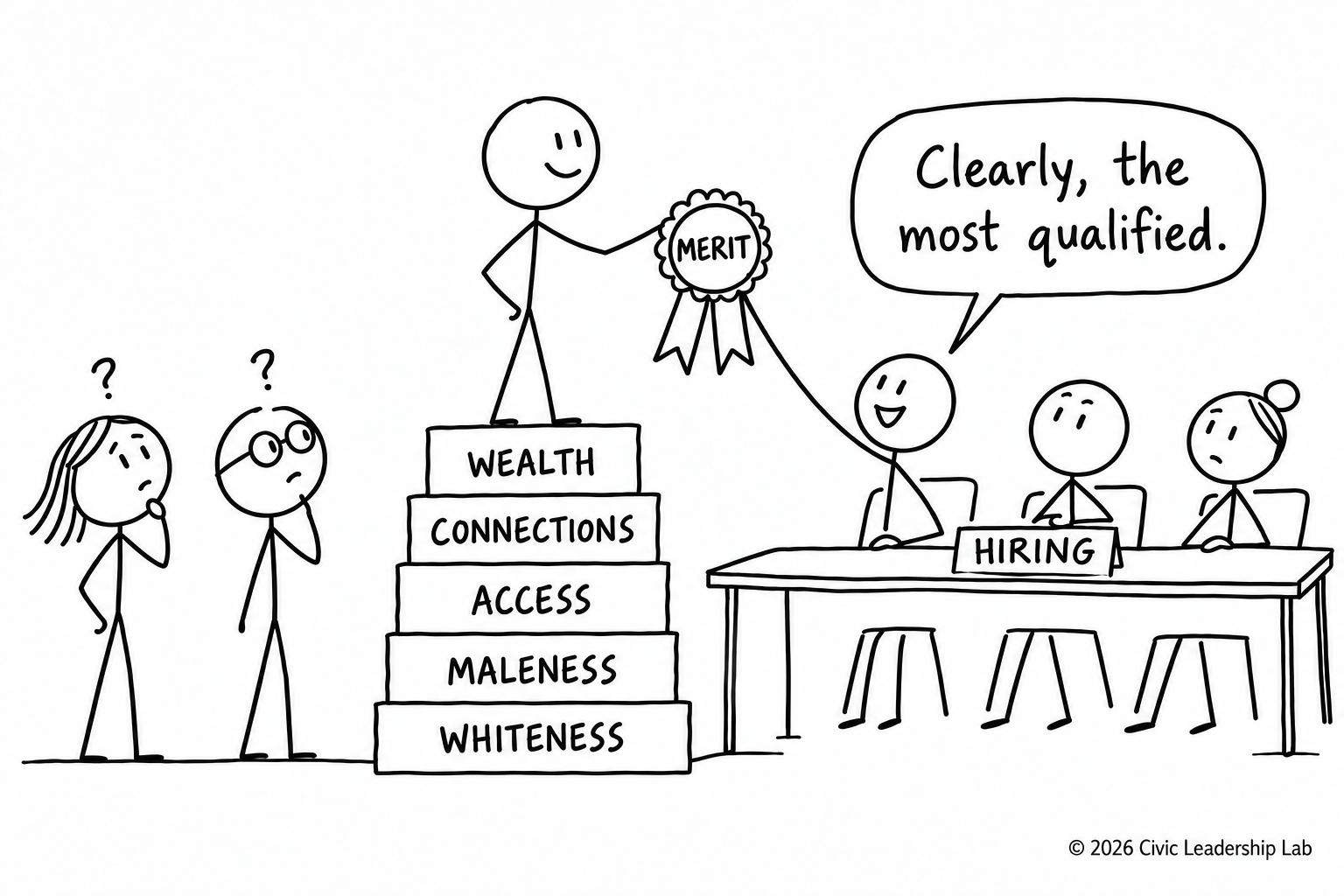
Meritocracy: Who Decides Who Deserves What?
Work hard. Get an education. Follow the rules. You will get ahead.
But will you, though? We live in a society that has different rules for different people. I’m almost certain that most of us know it’s true. Whether or not we want to acknowledge it is a different story.
What happens when people work hard and still can’t afford housing? When someone has the skills for a job but can’t get an interview? When the people making decisions repeatedly select people whose backgrounds resemble their own even though they swear up and down they “checked their biases at the door”? In my institution, we have to read a packet on bias if we are selected to participate in application reviews or interview panels! Or do discrimination, bias, racism, ageism, ableism—all the -isms and all the phobias—not exist in the institution because it’s a “merit-based” system? Let’s dig in.
What is a “merit”?
Merit refers to qualities considered valuable for a particular purpose. Take the civil service—our recruitment and hiring processes, our civil service rules, stipulate that we recruit, select and hire based on candidates meeting requirements for a particular job. Each job class spec has a very detailed description of minimum qualifications that an individual must have for that job (minimum education or equivalent experience, licenses are certifications, etc.) and a description of the job duties…don’t ask how frequently they are updated… We consider civil service to be a meritocracy. A meritocracy is used to describe a broader system for distributing opportunities, rewards, and power. Meritocracy is the idea that people gain positions and rewards through ability, effort, and achievement. It’s a nice idea. The reality is that merit selection is as old as dirt, or at least Imperial China, when it began using competitive exams as a way of gaining access to government service. In his 1956 article “Class and Equality,” Alan Fox challenged a society that identifies promising individuals, helps them reach influential positions, and then gives them greater material rewards as well. His objection was that improving opportunities for selected people could leave the hierarchy itself intact.
That is a deeper criticism than “the competition is rigged.” Fox was asking why winning the competition should entitle someone to so much more in the first place. Even a system that successfully identifies ability still has to justify how it distributes income, security, leisure, and respect. The Rise of the Meritocracy was published in 1958. Young was questioning what happened when success within those meritocratic systems became proof that someone deserved power. Prior to civil service rules, government jobs were handed out as political favors. Your qualifications mattered less than your connections or your willingness to support whoever was in office—sound familiar? In the United States, the Pendleton Act of 1883 theoretically began replacing that arrangement with competitive examinations and protections against political coercion. Someone still writes the examination. Someone decides whose knowledge counts, whose experience is relevant, and what a qualified person moves, looks and sounds like. It goes back further and makes for some uncomfortable truths.
Where does standardized testing and scoring come into this?
Once we say that people should advance on merit, we have to decide how to measure it. Standardized testing offers an appealing answer: give everyone the same assessment, assign scores, and rank the results. Using the same assessment does not settle whether it measures what matters—or whether we are justified in using its results to distribute opportunity and power. Again, nice idea, but part of this history runs through Francis Galton and Lewis Terman. Galton’s Hereditary Genius, first published in 1869, used prominent men and their family histories to argue that exceptional ability was inherited. He later coined eugenics, advocating the improvement of human populations through selective reproduction (Galton, 1869/1892; National Human Genome Research Institute, 2022). That’s right—eugenics. And on an aside, sterilization of minoritized women against their will (and more than likely without their knowledge), happens even today in the U.S.. Remember the detention facilities for undocumented people that ICE rounds up? Look it up. It made headlines briefly.
Now consider whose accomplishments became the evidence—Galton studied people who had already achieved recognition within existing institutions. Did anyone think that approach risks treating the advantages those institutions provided as evidence of the recipients’ natural superiority? Probably not. Easier not to. Fast forward fifty or so years and Terman helped turn the measurement of intelligence into a tool for educational selection. His 1916 Stanford revision of the Binet–Simon scale became known as the Stanford–Binet. In the accompanying book, he attributed higher scores among children from higher social classes largely to inherited ability. He also made racist claims about intelligence and advocated segregated instruction for children he classified as inferior (Terman, 1916). His conclusions extended well beyond classroom performance—he used those classifications to make judgments about children’s future work, their capacity for citizenship, and whether their reproduction presented a eugenic concern.
This is where measurement becomes power.
Are you seeing it now? An institution can use a score to determine who receives further education, who is directed toward particular work, and whose potential is worth investing in. If the score is treated as evidence of innate ability, the resulting inequality can be presented as justified. This is how recruitment selection and hiring works in civil service. The early critique of meritocracy challenged this relationship between measured intelligence and social hierarchy. Young’s warning concerned what happens when people selected through such systems come to believe that their advantages establish their right to occupy the top (Trevisan et al., 2022).
This connection doesn’t make every test a eugenic instrument. However, It does mean we should examine the assumptions behind an assessment and the authority attached to its results. And there are very practical and serious limitations to who does the assessing and whether they are qualified to be doing it, especially within public institutions. Nepotism, politics, all the usual backdoor handshakes happen in civil service, but it’s covered up by policies and procedures and paperwork and promises. It’s not just about fairness though, these questions are practical. Does the examination measure the ability to perform the work? To lead? Which forms of knowledge does it recognize? What preparation does it reward? This is an interesting question because there are ways to apply and interview in the public sector, tips and tricks that will give you a stronger chance of getting to the next step, you just have to know who to ask and where to look. And how much are we claiming to know about someone because of their score anyway? Especially in the time of artificial intelligence? A standardized process can make a decision consistent, but we still have to establish that the decision is justified.
Moving those decisions into a formal process doesn’t remove power from them, it memorializes the bias. As society evolves, so do the biases. There are adjustments, modifications, but no structural change or examination. The core inequity still exists. The biases have been tweaked just enough to appear progressive while replicating the dominant paradigm.
Historian Heather Ellis (2023) offers a concrete example in her research on the British administration of India. Ellis argues that changes to civil service examinations increasingly favored classical studies as Indian candidates became stronger competitors—and therefore happened to favor upper-class British candidates educated at Oxford and Cambridge. Competition could be organized in ways that protected the people already positioned to win. This is where Critical Race Theory helps us ask a better question. How do institutions reproduce racial inequality through ordinary rules and practices, including those described as neutral. What about this notion of “colorblindness”? Kimberlé Crenshaw’s work challenges the assumption that formal “colorblindness” adequately addresses continuing racial subordination. Applied to civil service, that means examining how qualifications, selection practices, and institutional histories interact. Intersectionality makes that examination even more precise. In her foundational 1989 article, Crenshaw shows how treating race and sex as separate categories could erase discrimination experienced by Black women. An institution can recognize discrimination against women through white women’s experiences, and discrimination against Black people through Black men’s experiences, while failing to connect what happens at their intersection as Black and Woman, who experiences discrimination not only because of ”femaleness”, but even moreso for her Blackness. So when we read “women are advancing,” it actually tells us very little about which women.
But the Numbers Look Good
A workforce can become more representative in the aggregate while particular groups remain concentrated in lower-paid positions or excluded from leadership. The rejects, the black-listed, the minoritized—have we asked how they experience the workforce? The opportunities for advancement? The respect? We must examine those possibilities rather than treating an overall number as the answer. This lends itself directly to the idea of the haves and the have-nots. In Littler’s piece Young and Old Meritocracy: from radical critique to neoliberal tool, they write: “(‘The idea of meritocracy may have many virtues’ wrote Amartya Sen, ‘but clarity is not one of them’). And crucially, it indicates that the expanding use of the idea of meritocracy over the past few decades has served as an extremely potent, yet highly flexible, justification for contemporary capitalist culture.” (2018) Contemporary capitalist culture is neoliberalism, a political and economic ideology that advocates for free-market capitalism, minimal government intervention, and the expansion of private sector roles in society. In other words, a caste system based on wealth and access. Bureaucrats are the gate-keepers. They’re not the wealthy themselves, they are more like parasites that have an unspoken agreement (willful ignorance?) with the wealth-class, the ruling class. We can even go deeper: Robin Dembroff’s work helps push the question further. In Real Men on Top, Dembroff examines how patriarchal ideas organize our understanding of human worth and make hierarchy appear natural. Their account also challenges the assumption that patriarchy benefits all men equally. In drawing on Dembross’s framework, I bring that argument into civil service by asking: whose behavior gets recognized as authority? When we describe someone as confident, professional, objective, or leadership material, what expectations are we applying? Who is allowed to be forceful? Whose disagreement becomes evidence that they are difficult? Together, these perspectives help us examine both access to opportunity and the standards used to measure and judge people once they arrive. Racism, patriarchy, ageism, ableism, homophobia, transphobia, and class privilege can shape what an institution recognizes as competence—and whose competence it struggles to see.
I want public employees to have the skills their work requires—I am one of the public—I don’t want someone who isn’t an engineer, doing engineering. For example, I should not operate the Sheriff’s helicopter, as much as I’d like to. I’m not qualified—I’ve never been in a helicopter. I am, though, a public servant , and as a public servant, I don’t want leaders—directors, managers, supervisors—who don’t lead. I want institutions to account for how they recognize leadership skills, whose knowledge they dismiss, and whether their processes serve the communities affected by their decisions. Calling a process merit-based should begin that interrogation, but too often, it ends it. After all, how would those leaders benefit from changing the status quo?
Public Good? What’s in it for me?
California Department of Human Resources. (n.d.). Merit system principles—An overview.
Crenshaw, K. W. (1988). Race, reform, and retrenchment: Transformation and legitimation in antidiscrimination law. Harvard Law Review, 101(7), 1331–1387.
Crenshaw, K. (1989). Demarginalizing the intersection of race and sex: A Black feminist critique of antidiscrimination doctrine, feminist theory and antiracist politics. University of Chicago Legal Forum, 1989(1), 139–167.
Dembroff, R. (2026). Real men on top: How patriarchy shapes our reality. Oxford University Press.
Ellis, H. (2023). The Indian Civil Service, classical studies, and an education in empire, 1890–1914. The Historical Journal, 66(3), 593–618.
Galton, F. (1892). Hereditary genius: An inquiry into its laws and consequences (2nd ed.). Macmillan. (Original work published 1869)
National Archives. (2022, February 8). Pendleton Act (1883).
National Human Genome Research Institute. (2022, May 18). Eugenics and scientific racism.
Smithsonian National Postal Museum. (n.d.). Woodrow Wilson: Federal segregation.
Terman, L. M. (1916). The measurement of intelligence: An explanation of and a complete guide for the use of the Stanford revision and extension of the Binet–Simon intelligence scale. Houghton Mifflin.
Trevisan, F., Rusconi, P., Hanna, P., & Hegarty, P. (2022). Psychologising meritocracy: A historical account of its many guises. Theory & Psychology, 32(2), 221–242.
Young, M. (1958). The rise of the meritocracy, 1870–2033: An essay on education and equality. Thames and Hudson.
Young, M. (2001, June 29). Down with meritocracy. The Guardian.