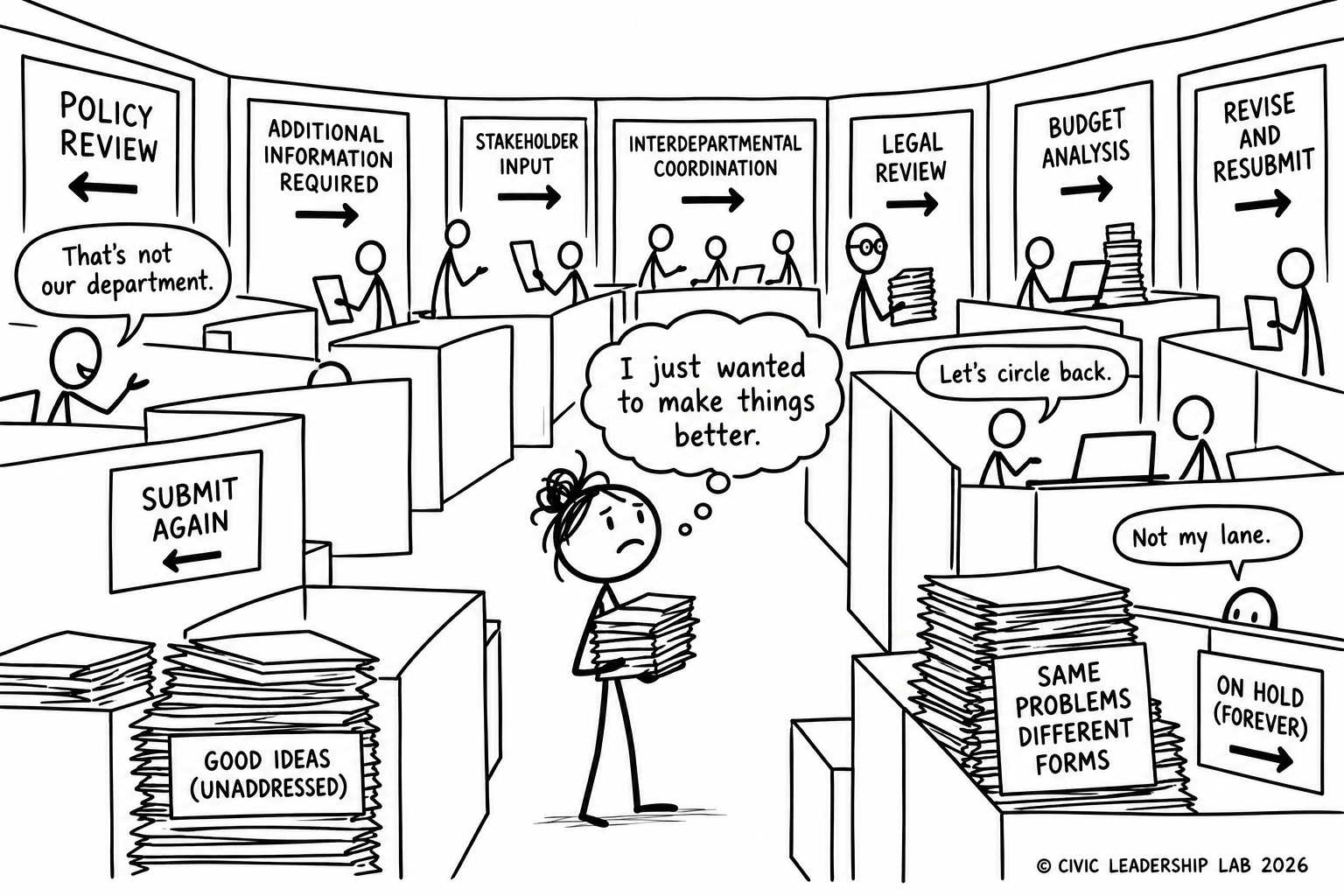
Rules are supposed to protect us from the arbitrary exercise of power, but what happens when following the rules becomes more important than understanding whom they're supposed to protect?
Institutions. Gotta love ‘em. Bureaucracy doesn't just organize our work. It organizes our relationships, determines whose knowledge counts, and teaches us what kinds of power we're allowed to exercise. There are also an abundance of redundancies in the operation of institutions. The redundancies are there for a reason, we’ve just forgotten why we have them in the first place.
Let me ask you, do you ever wonder why a simple interaction with a public agency can leave everyone feeling like an asshole? Bureaucracies are where compliance replaces judgement, resulting in good old-fashioned alienation, personal and societal. Karl Marx’s theory of alienation is where a worker becomes disconnected from the product they create, the act of production, human nature, and their fellow workers. Add modern tech and AI and it’s hard to see the light at the end of the tunnel—we seem to have lost any self-awareness or empathy. In addition, we are alienating ourselves from our own ability to think critically by making everything easier, more convenient—we have stopped trying, learning, questioning, growing. We can just ask a bot. We’re not problem solvers anymore. We are living the film Idiocracy (though Terry Crews would probably make a better president than what we’ve got now.)
Think about it. Everything comes down to a policy, a rule, a guideline, especially when one works in a public agency. There is a process for everything. There are processes for how to create a process. If we write it down and memorialize it, if we keep refining and iterating on it, if everyone would just follow the rules, everything will work out. Sure, there’s something satisfying in telling people what to do, how to behave—our inner fascists. But when do the rules stop and where does free will begin? What happened to our personal agency? Bureaucracies—public institutions—are supposed to protect us from arbitrary human judgment. However, in attempting to eliminate uncertainty, they institutionalize the very biases, hierarchies, and indignities they are supposed to prevent. Policies alienate us from eachother because they strip away humanity, the lived experience. The answer is as simple as the human need for control. We humans have a need to create order from chaos. In general, if we can account for all the variables, we can avoid bad things. If we can prepare enough, we will be ok. If we do everything properly, by the book, we can’t fail. It comes as one helluva shock when everything falls apart just when you thought you had it down.
Most of the people I’ve had conversations about alienation with, see the need for bureaucratic reform but feel the system is impossibly complicated. So complicated, in fact, it has practically rendered itself tamper-proof—the institutional version of a bottle of advil. Whether by design, by decades of accumulated decisions, or actual child-proofing (see current administration), bureaucratic complexity can accomplish something very convenient: it discourages participation, rewards those who can navigate the system, and allows institutions to mistake survival for success. Well meaning as we progressives are by modifying policies, language, missions and values to rein in disparities, what are we trying to accomplish? Whatever it is, it’s not having the impact we intend. Are we making these performative changes because they’re easy or because we don’t see another option? What about something else? Could we be ignoring the obvious? Public agencies have to operate within this economy too. It always comes down to money—making it or saving it. If someone can’t navigate the system, they’ll stop trying to use it. It’s a cost savings. Internally, it also weeds out the squeaky wheels—if you frustrate them enough, they’ll take their ideas and leave. Or they’ll end up self-selecting out of participating in the system, they give up. This is what happens at work when people are disengaged—they become demoralized and the job becomes an unavoidable burden, not a place for growth. On the other hand, if you are able to follow the rules and jump through all the hoops, you reinforce the perception the system works and is successful. The successful participant then becomes the poster child, the spokesperson, for the “pull yourselves up by your bootstraps” campaign. It’s by design. Who do you think gets the promotion? The hoop-jumper, the obedient child, the line-toer. Obedience is necessary for an institution to continuously legitimize its authority, to maintain the status quo.
Civil service: This is how we roll.
We civil servants save everything, we have to. Between the CYAs (cover your ass) and the PRAs (public records requests—the reason for the CYAs), paper trails are critical, especially taking into account how much we get sued and how often we file complaints against each other. And how about the meetings? I bet if half of our meetings went away, we would probably maintain productivity levels, hell, maybe even increase them. Nowadays, instead of being paper pushers, we are point-and-clickers. We upload things to the cloud—archives filled with files and templates, hundreds upon hundreds of procedures and policies. When I step back and think about how much time we spend on paperwork just from putting out fires, I see that we have become so rule-focused, we have disengaged from the actual work. Add to that the impacts of Covid and the advent of Tik Tok, we’ve also disengaged from each other. If the nature of our work and the state of the world today alienate us from our jobs and each other, what happens to our humanity? We become functions. Our clients become transactions. The applicant becomes a score and doesn’t even register on the human scale—just paperwork. We no longer interact as individuals. That’s so depressing.
I’ve found that a good portion of the work we do in civil service could easily be replaced—with better systems, better policies, better implementation and roll out. I like to imagine what would happen if we, as a community, took the replaceable time and focused on collectively redesigning the institution itself, rather than reincarnating it through societally acceptable processes for change: programs and workgroups. We are the copy-and-paste workforce (literally). We make adjustments to the fads, the performative justice, the low-hanging fruit of change, not to the agency itself. We have to account for our salaries, so we fill our workdays with approved redundancies to give the impression we are not wasting tax payer money. The problem is not the random time-suck that happens in every job. The problem is that tax payer money goes to consultants and law firms in the millions every year, rather than being used to invest in our own workforce, the people who work for the community. Why not educate them to do the work we’re paying consultants for? Here's a question worth asking: What happens when the people with ideas, expertise, and firsthand knowledge of institutional problems don't have the positional authority to change them? And what does it say about an institution when the authority to make decisions matters more than the knowledge required to make them well?
Just ask the father of bureaucracy himself, Max Weber. He defined bureaucracy as a highly structured, formal, and impersonal organization governed by clear rules, a defined hierarchy, and technical competence. Like Adam Smith and his caution about capitalism without empathy, Weber, too, expressed caution and worry. He introduced the concept of the "iron cage" to describe how rationalized, bureaucratic systems can trap individuals in a cold, rule-bound existence. So, the next time you find yourself frustrated by a public employee—or you’re the public servant frustrated with someone you're serving—consider the possibility that neither of you is the problem. Maybe you're both trying to navigate a system that has confused order with justice and compliance with competence. Institutional mechanisms make ordinary human relationships unnecessarily adversarial. Maybe the most radical thing we can do is become curious about one another again. It’s a start.
My questions for you are, how do institutions change the way people relate to one another—and as leaders, how do our attempts to create fairness, predictability, and order actually undermine all three? What would public service look like if we designed it around human beings instead of expecting human beings to organize themselves around the rules?